Friday, 29 May 2015

Would you eat your own Poo?

Squatting in front of a classroom, demonstrating what consuming your own faeces might look like, it's hard to know if you're at a high or low point in your career – probably a bit of both.
While the nursery school and clinic have been progressing, Paul has been busy with a couple more water projects. With the well finished and providing plenty of water on a daily basis, we decided to tackle a couple of other issues that would help keep the water flowing at Buhangija.

The centre has two large rainwater harvesting tanks but, like the well, they’re broken. One has a cracked, damaged roof and the other has no cover at all. The roofs and gutters feeding the tanks are dirty and damaged. The open tank is full of green, stagnant, rubbish filled water – completely unfit to be used for cleaning, let alone drinking. Yet every day, children, particularly the small ones, fill bottles with brown / green water, seemingly oblivious to the fact that water isn’t supposed to be that colour.  Seeing a child wrap a corner of their t-shirt around the neck of their bottle in an attempt to ‘filter out’ the bigger pieces of dirt has become a common sight.
 
So we found some local technicians, went shopping for materials and started the work of fixing the tanks. As well as putting on a nice new roof, we cleaned the existing catchment areas and gutters and added a new stretch of guttering to get as much water as possible. Rainwater harvesting is a good solution to provide water during the dry season in Tanzania. Rainfall levels are quite high during the wet season so being able to collect that means you have a supply of water the whole year round. To see more pictures of the tanks construction, click here.

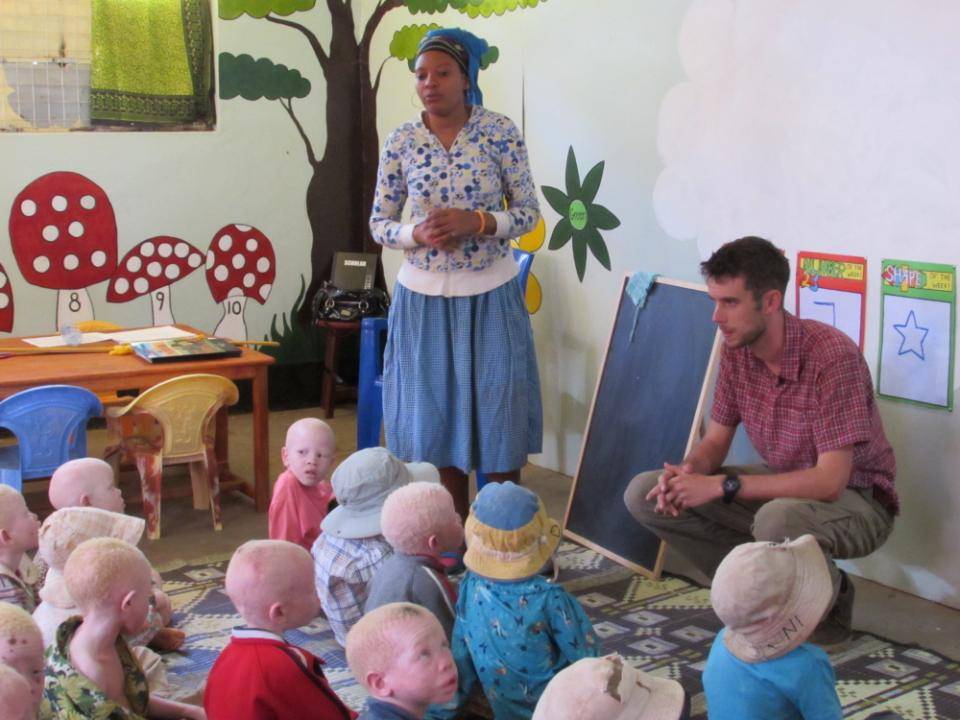
We have also fixed showers, added hand washing taps and cleaned toilets. However, we realised early on that we could do as much as we wanted with the ‘infrastructure’ but unless it was coupled with some education and training, it may not bring any benefit to the health and well being of the kids. Hence Paul’s attempt to explain to a group of children that not washing your hands with soap is like eating your own poo. Thankfully, they saw the funny side and shouted ‘hapana’ (no) when the key question was put to them. Expounding the health benefits of hygiene doesn’t work, especially where children are concerned, but disgust and some healthy peer pressure has been proven to make an impact. So hopefully watching the ‘mzungu’ pretend to do something so revolting might just stick with them the next time they use the toilet or go to eat food!
 
As the children are prone to forget, we have told the matrons that every child should wash their hand before meals and so, one evening last week, we stood in shock and a hint of pride as we watched 80 children sent to the sinks before receiving food. We’re hoping this will continue.

Swahili word of the day: Kosha Mikono kwa Sabuni (Wash your Hands with Soap – now on signs above sinks and hand washing stations)

Thursday, 21 May 2015

Buhangija Clinic

As we’ve moved into our final few weeks in Shinyanga, we have been hard at work in Buhangija, trying to make best use of the money that’s been donated before we leave. Great strides have been made in the past few weeks in coordinating and unifying the people who have invested their time and money into Buhangija. Meetings have been held with all those involved and this new communication has meant that there has been a renewed, coordinated effort in our work at the centre.

Buhangija is a government run institution, and at times there are many layers of bureaucracy that must be waded through before action can be taken. We have had many difficult discussions with the various people involved, acknowledging that any work we do removes responsibility from the people in charge. Sometimes, sustainability in an environment like Buhangija seems like a distant dream!

As mentioned in a previous post, over the past couple of months we have working alongside ASMK, a Shinyanga based NGO. With their support, we decided to address the daily hygiene and medical issues in Buhangija by establishing a clinic. The children have no access to any form of healthcare and it is usually Claire or ourselves who tend to cuts, blisters and sunburnt skin.

ASMK had secured funding from Dar es Salaam and combined with the generous donations we have received from Ireland, we reckoned we had sufficient money to set up a room and hire a nurse.

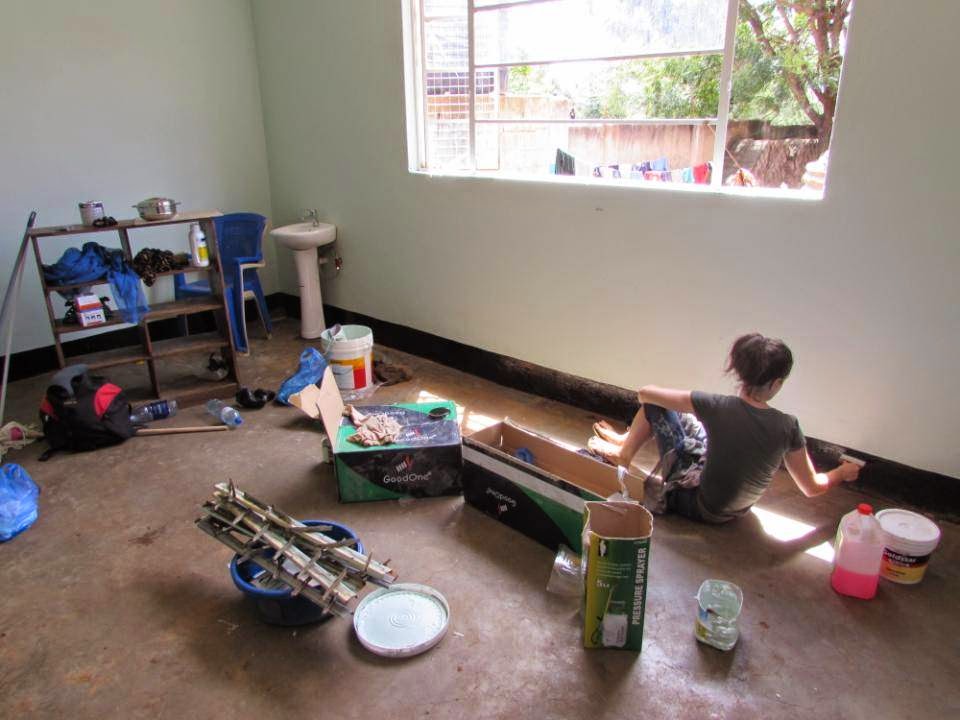
So we dusted off our painting clothes, employed a carpenter, fixed windows, installed a sink, found a bed and now, in a room off the youngest children’s dorm, there is a small, bright, clean clinic. It is here that our newly employed nurse, Madam Felicia, will work five and a half days a week to provide onsite medical care and advice. To see more of the renovation process, click here.

Today was the first day of the Buhangija clinic, Madame Felicia arrived in her new uniform ready for work. After some brief introductions, she was busy cleaning kids, tending wounds and disinfecting cuts. A retired nurse and mother of six, she has approached the job with enthusiasm. Serious medical needs will still be tended by a doctor but now she is in Buhangija, there is someone to actually contact the doctor! In many ways, what the children need is a mother, someone who will love and care for them, rather than a medical professional. We are thankful that in Mama Felicia we have found someone who ticks both boxes.
 
The children of Buhangija still need more to be done to increase their quality of life to a basic level but we're hoping this is part of a good start.

Swahili word of the day: Dawa (medicine – a favourite of the queue of kids outside the clinic door!)

Saturday, 16 May 2015

Time to Say Goodbye

As with all good things, our time in Shinyanga is coming an end. The work we’re involved in here is nearing completion and a few months ago Tearfund broached the idea of moving us to a different part of Tanzania to work on community development projects there.
So sometime next week we’ll be bidding a sad farewell to ‘Shy Town’ and travelling to Geita. Our new home will be in north western Tanzania, about 3 hours from Shinyanga and the same travel time from Mwanza (where the airport, delicious pizza and Indian food can be found) so we’re not going too far. Geita is smaller than Shinyanga but as the centre of a major gold mining area is busy and growing – we’ve even heard rumours of a possible swimming pool!
 
It took a while but we have become familiar with life here in Shinyanga – and people have become very familiar with us. We know where to get stuff, our favourite restaurants know our order and we now have a long list ‘fundis’ if anything breaks. However, we have been considering Tearfund’s request for a few weeks and with heavy hearts think that the time is right to move on.

We are moving to work with the AICT Geita Diocese. Their development team are currently trying to progress some local sanitation and hygiene initiatives, would like to introduce water filters and have received funding to install a number of wells by October. Paul is looking forward to getting stuck in!

Our time in Shinyanga has been great but a very steep learning curve. We have made good friends here and will be sad to leave a town that feels like home. The past couple of months in Buhangija have been very busy and sometimes challenging but recently have begun to feel very rewarding. We will be leaving our projects here in the capable hands of Claire and ASMK but are already planning regular visits.

Swahili word of the day: Kwaheri (goodbye)


Thursday, 30 April 2015

The Big Clean

No words could describe’ is such a trite phrase, generally thrown about when you can’t be bothered to think how to properly represent something. Yet a week’s research could not provide the words to fully capture the utter stench, the thick, heavy air of the dormitories in Buhangija. In the smallest kids dormitory, the mattresses are sodden with urine and crawl with bed bugs, disused mosquito nets hang from the ceiling collecting dead insects, the ceilings are covered in cob webs. The toilets don’t flush, there’s no sink in the bathroom, open defecation is common practice, the place is disgusting. It’s here that over 100 tiny heads sleep every night, in 46 beds.

The task of ‘cleaning up Buhangija’ has been on our minds for a while but was always put on the back burner as a job overwhelming in the extreme. Then we met Sam and Liliane, a couple who don’t seem to know the meaning of the word overwhelming. Liliane is a ‘Shinyang-ian’ by birth and after spending most of their lives in Canada, they returned to her home town and established an NGO (called ASMK) in honour of Liliane’s late grandmother. One of their goals for this year was to try and improve conditions in Buhangija and they have supported and encouraged us as we’ve worked together to that end over the past couple of months. Liliane’s Swahili, local contacts and natural cultural awareness has helped things to progress far smoother and quicker than if we’d been working alone. During a meeting we suggested a cleaning day so they hired staff, collected supplies, liaised with staff and even decided that it would be a good opportunity to train the matrons – they had no idea what they were in for!

And so we turned up at 7am armed with a Landcruiser full of cleaning supplies to be met by some equally bleary eyed and excited children. Our cleaning crew arrived and we were off. Beds were stripped, mattresses taken outside to bake in the sun, all clothes and trunks removed, floors swept, washed and bleached. Beds were hosed down, sheets boiled in dettol, new mattresses secured and covered in plastic. It was a long day! With one dormitory done we moved over to the older girls and began the whole wonderful, bleach filled process again. Matrons washed all the kids clothes and hung them in the sun to dry. Liliane held mini training sessions, all ‘pole pole’ and in keeping with the Tanzanian culture of not criticising, but clearly showing how achievable hygiene is and that new standards should and could be upheld.
 
At the end of the day we were putting the freshly washed sheets on the new mattresses, a few of the older girls came in to help. We watched as one girl buried her nose in the clean fabric and breathed in the scent of washing powder. She laughed and called her friends who joined her sniffing their fresh sheets. The beautiful smell of clean.

Swahili word of the day: Sabuni (soap)

Friday, 17 April 2015

Painting 'til we're Blue in the Face


In an effort to keep ourselves busy, and taking advantage of the extra pair of hands that arrived in the form of Ian, we have been doing some much needed renovation work in the AICT school over the Easter break. With the students and teachers away on holiday, we took the opportunity to sneak in and arrange a surprise.

The previous school painting days, while a lot of fun, focused on the outside of the school. Despite pleading, the inside of the rooms were left to their dismal, grey, unfinished interior - a disappointment to both staff and students. So when some special funding arrived from Ireland specifically for the Secondary School here, we knew exactly what we would do with it.

We arrived up to an eerily empty school with Ian and Whitney in tow and got to work. The icing on the cake came in the form of the School’s Academic Master, Mr. Kibasi who arrived unexpectedly and enthusiastically painted with us. Moses, our Bajaj driver, who had arrived simply to drop off Whitney also decided to stay and pick up a brush.

Painting in a rainstorm, with thunder so loud you can’t hear each other shout was quite a feat. The windows in our school have no glass so we had some fun trying to actually keep the paint on the walls at one stage! It also meant the Bajaj got stuck on the way home and we got soaked pushing it through the mud but all part of the fun.

The students in Form 2 ask most weeks when the inside of their room will be painted and so they’ll definitely appreciate their new, bright, clean (and blue, it's always blue!) learning environment.

Swahili word of the day: Mvua (rain – there was a lot of it!)


Friday, 10 April 2015

A Job Well Done

In the middle of Buhangija, there is a well. A well that is dry, broken and waterless. Like so many things in the centre, it was installed by visitors with great intentions and provided water for many months but through lack of care and maintenance, it is now just another piece of metal for the children to play with.

Its disrepair is felt keenly during the mains water outages that happen so frequently here. We can manage for 8 days without water; 350 children just can’t.

A few weeks ago Paul asked Mr Magunya to come and visit Buhangija. Mr Magunya is a retired man from our church who has managed water projects for Tearfund, Caritas and Hilfe fur Bruder to name but a few. He immediately grasped the seriousness of the situation for the children who live in Buhangija and has worked tirelessly for the past two weeks. A grandfather himself, he has also been spotted taking a quick break from work to play games with the little ones who crowd around him to watch. His attitude and commitment to working for the good of the children is very encouraging. He knows his stuff and has been able to find all the fundis (technicians) that we need – in very quick time for Tanzania.

Two weeks ago we opened the well and fortunately, found the pump in good shape - needing just one new part and a bit of cleaning to get it working again. The condition and depth of the well itself however needed closer examination and there’s only one way to do that – send a man with a bucket 15m down a rope to have a good poke around! The first few loads out of the well were full of sticks, shoes, bottles and even other buckets.

Cleaned out, the well had just over 1m of water. A quick ‘pump’ (bucket removal) test showed recharge was disappointingly slow. We decided to try to clean and deepen the well to have deeper, faster water. For 5 days the ‘well fundi’ climbed down the rope and dug in the near darkness to remove dirt, soil and rocks from the base and sides. On the last day, the buckets of dirt were interspersed with buckets of water as it started to flow in as fast as we could remove it – “good for the well, bad for the workers” was the very appropriate quote! The end result is over 3m of water that’s refilling at an amazing rate.

Re-installing the pump and watching fast, clean water flow out was a great moment and one that was much enjoyed by the children and staff. It took time but the well is fixed and should provide around half a bucket of water per child per day. The nature of Buhangija is that things are not well maintained and tend to break. In an attempt at sustainability, we have arranged for Mr Magunya to visit every three months to check on all things water related. Hopefully that will help to keep the water flowing in Buhangija for many years.
  
Click here for more photos.

Saturday, 4 April 2015

Easter Visitor

Ian has arrived. After a quick stop in Dubai, he landed in Mwanza last Friday and will be here until next Wednesday. Activities undertaken so far include swimming in Lake Victoria (just Ian, we'd rather not contract bilharzia), fixing wells, getting a bajaj stuck in the mud, arguing over whether his arms are red or brown (they're very red), eating double chips mayai, hiring an arc welder (and sending it back due to significant Health and Safety concerns) and shopping for goats.

We've been filled in on all the important recent events from Ireland including the new layout at Newlands Cross, The Rock returning to Wrestlemania, the price of a mans lycra top in Penneys, how good Taylor Swift's new album is and that being here means missing a free McDonald's breakfast in Swords - so we're well up to date.

It's great to have Ian here and that's not just because of the large case of chocolate, sausages and cheese - the main things we miss from home. We're showing him the delights of Shinyanga and we think he's enjoying it. We've a Serengeti trip in the pipeline so looking forward to that. We really appreciate the effort to make it this far and a familiar face from home is always very welcome! 

Swahili word of the day: Wageni (visitors)